


THE EFFECTS OF AGRICULTURAL EXPANSION FOR CULTIVATION AND CONSEQUENCES OF ILLEGAL LOGGING IN JALISCO STATE, MEXICO
Cristiana Harless, Sinead O’Carroll, Martina Elena Nitti, OSINT-RDT Team
Matlhatse Saadiyah Letsoalo, Editor; Jennifer Loy, Chief Editor
October 14, 2026
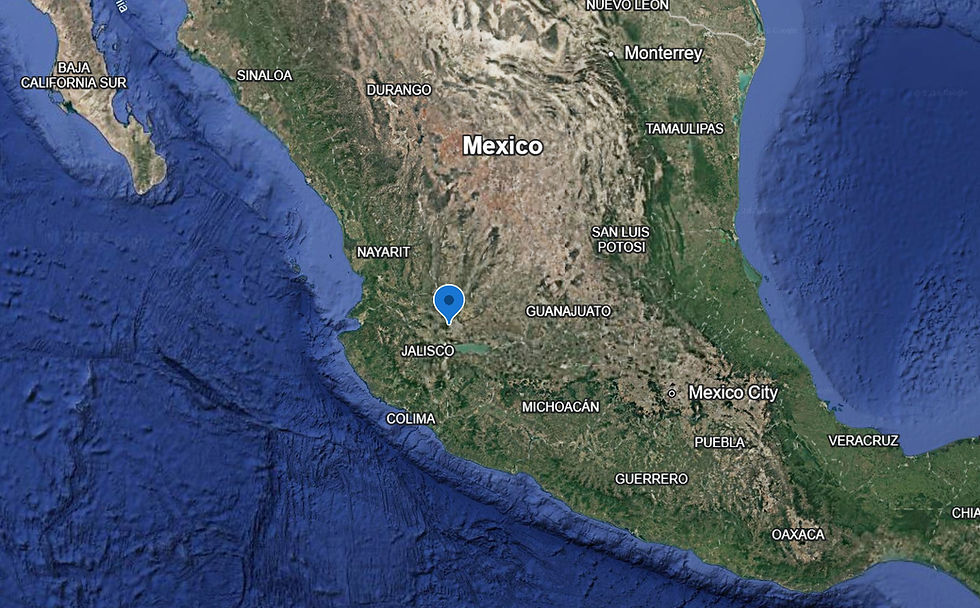
Jalisco State, Mexico[1]
Key judgments
The practice of illegal logging in Jalisco State, Mexico, poses a threat to environmental and human security, as well as a country-wide security problem. The presence and proliferation of criminal groups and cartels operating in Jalisco State, alongside the economic benefits they derive from illegal logging in terms of revenue and illicit economic practices, including drug production, further compound these security risks. The lack of government representation and failure to enforce environmental acts, including the Sustainable Forest Development Act and the Ecological Balance and Environmental Protection Act, against land-use change also fail to protect farmers operating legally and expose them to exploitation, gang violence, impoverishment, and lack of resources, including access to natural water sources like rivers and streams, which criminals use to sustain their avocado plantations. This study analyzes the causes and growth of this phenomenon, as well as the results of illegal logging and the presence of criminal groups and cartels in Jalisco -between 2018 and 2025. The team selected and analyzed the area around Paseo San Gabriel, Ciudad Guzmán, Jalisco, using geospatial intelligence (GEOINT) tools, such as Google Earth, combined with secondary sources, to provide a clear picture of the spatial extent of deforestation and land impoverishment and explain the associated security concerns.
Tracking forest loss and avocado expansion and consequences of illegal logging in Jalisco, Mexico
Region and focus of the study: This study analyzes illegal logging, especially related to avocado production and plantations, in Jalisco, Mexico. Although land-use change is prohibited without government approval, criminal groups and cartels exploit the limited government presence and weak enforcement of the Sustainable Forest Development Act and the Ecological Balance and Environmental Protection Act. These conditions allow them to exploit local and Indigenous communities, deforest areas, and raid crops to establish avocado plantations in their place.[2]
Investigative focus: Avocado plants are among the most water-consuming trees. Criminal groups irrigate their plantations with water from rivers and streams in the area, which heavily diminishes the natural water capacity of rivers and lakes, consequently reducing water availability for nearby communities that depend on these sources for basic needs, light agriculture, and commercial activities.[3] Between 16,000 and 28,000 hectares of land support avocado plantations, roughly supplying 40 percent of avocados’ global demand, which is a big incentive for criminal groups to engage in illegal logging.[4] The revenues connected to the market deeply interest criminal groups for the side production of methamphetamine and fentanyl, which they can conceal with logging.[5] Illegal logging also threatens human security. Criminals often exploit indigenous and local communities, forcing them to work in avocado plantations with little to no economic benefit and using threats, gang violence, extortion, and other violent methods, including kidnappings and fatal shootings.[6]
Affected points:

Paseo San Gabriel, Ciudad Guzmán, Jalisco State, Mexico, March 3, 2018[7]
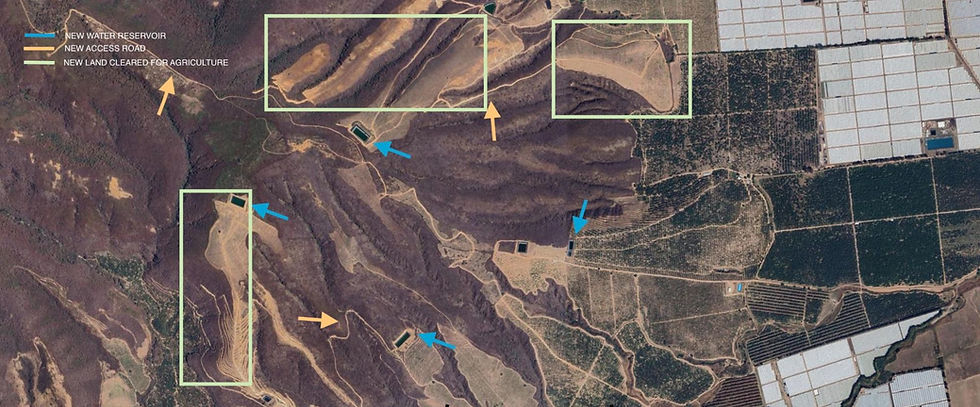
Paseo San Gabriel, Ciudad Guzmán, Jalisco State, Mexico, February 27, 2025[8]
Patterns between affected points:
Terrain changes: In the 2018 image, the terrain appears greener, with limited land cleared for agricultural purposes (highlighted by the green arrows on the left side of the image). The remaining land appears to be in its natural state. The area has no additional water reserves, man-made or natural, and no natural streams. In the 2025 image, new areas of land (highlighted by the green boxes) appear to have been cleared for agricultural use at the top and on the right. The entire area shown in the image appears browner, with limited patches of green vegetation toward the right.
Physical changes: In San Gabriel, the 2018 image shows limited areas of controlled, man-made cultivation, particularly on the left side of the image, while the remaining area appears to be in its natural state. The 2025 image shows a decrease in existing orchard areas, which now feature grid-planted rows of trees, indicating expanded cultivation. The image also shows at least four new irrigation reservoirs, as well as new dirt access roads linking farms. These additions likely indicate organized, well-financed operations aimed at supporting intensive farming and agricultural activity.
Secondary sources
The Mexican government’s ineffectiveness in controlling illegal logging in Jalisco will very likely exacerbate existing grievances from indigenous and local communities subject to criminal groups' exploitation. Criminal groups engaged in illegal logging will likely reinforce their presence in this territory over time, leveraging operational structures, personnel, economic resources, and local knowledge to support other illicit activities, including drug trafficking. The proliferation of criminal agents in the logging industry, combined with high Mexican avocado exports, will likely contribute to a country-wide security and economic crisis. Continued unregulated logging, criminal activity, and resource exploitation in Jalisco will likely lead to severe human and environmental security problems, including extensive deforestation, water scarcity, and a lack of better, legal economic opportunities for all inhabitants of logging-interested states. Residents will likely continue to distrust domestic regulatory mechanisms and reporting channels in response to widespread intimidation from criminal groups.
Mexican law requires permits and environmental impact studies before land conversion, and prohibits the use of arson or logging for land use change.[9] In Jalisco, groups illegally enter forested areas and log without permits, sell the wood, and convert the land into avocado plantations, violating the Sustainable Forest Development Act and the Ecological Balance and Environmental Protection Act. Both laws prohibit intentional forest clearance that precedes land-use change.[10] Bribery of local officials has allowed initially unauthorized land use to move above board as groups illegally obtain permits,[11] and land- and water-use laws remain difficult to enforce given the economic incentive of avocado exports.[12] Criminal groups will likely keep profiting from clearing and converting land in Jalisco and surrounding areas. Avocados are among the top water-consuming fruit crops, and producers rely on the diversion of local water supplies for irrigation, likely increasing pressure on local ecosystems.[13]
The United States' (US) supply of Mexican avocados comes entirely from Jalisco and Michoacán, where plantations have replaced up to 28000 hectares of forest.[14] In Michoacán, 80 percent of avocado plantations begin illegally.[15] Groups carry out logging during the day, using expensive tools such as bulldozers, and set fires to clear large areas of forest quickly, indicating an expectation of minimal legal ramifications.[16] The openness of these groups' methods likely suggests that illegal clearance and conversion are routine in this region for establishing avocado orchards. Logging is one of the most profitable natural resources for criminal exploitation, and control of avocado exports would remove a key source of income for criminal groups.[17] Cartels rely on the exploitation of natural resources such as avocados to fund the production of drug-related chemicals and to avoid anti-money laundering regulations.[18]
Increasing global demand for avocados has encouraged criminal groups to extort producers and steal from shipments.[19] Climate Rights International recorded more than 30 acts of intimidation in relation to the production of avocados, including fatal shootings, assaults, and kidnappings.[20] In 2024, the US halted avocado inspections in Jalisco in response to the assault and detainment of two United States Department of Agriculture investigators.[21] Mexican authorities have described attacks on avocado farm inspectors as non-violent and unrelated to organized crime, a characterization that reporting does not support.[22] Criminal groups, militias, and corrupt police have forced local farmers into expensive protection rackets and kidnapped local citizens to coerce unpaid labor.[23] These actions likely indicate that local communities largely do not support the illegal deforestation and land conversion associated with avocado orchards. 60% of Mexico's national forests belong to community ownership schemes, where the government provides agricultural tools and training, and illegal logging mostly affects communities who do not manage their own forest.[24] As demand for avocados increases and enforcement continues to fail, organized crime groups will likely expand operations into community-owned forests, increasing the risk of conflict and violence in these areas.
Conclusion
Agricultural expansion for avocado production in Jalisco, Mexico, has likely driven illegal land-use change that Mexican authorities are unable or unwilling to address. Satellite imagery analysis of the San Gabriel municipality between 2018 and 2025 shows forested hills replaced by grid-planted orchards, newly constructed irrigation reservoirs, and access roads. Criminal groups have embedded themselves in the logging and avocado industries using arson, violence, and extortion against local communities, inspectors, and producers. Corruption and bribery of local officials have incentivized these groups and allowed them to retrospectively legitimize unauthorized deforestation and land-use changes. Google Earth imagery clearly shows the scale of this agricultural change, though irregular satellite capture dates and seasonal changes in landscape colors limit how far back deforestation can be analyzed. Satellite imagery does not indicate the ownership of specific avocado orchards. Continued monitoring of this area and the wider regions of Jalisco would likely clarify the progress of illegal logging and avocado cultivation.
[1] Jalisco, Mexico, via Google Earth
[2] Illegal Logging in Jalisco, Commission for Environmental Cooperation, May 2023, https://www.cec.org/submissions/registry-of-submissions/illegal-logging-in-jalisco/
[3] Arson, logging and water theft: The avocado industry deforests Mexico, El Pais, November 2023, https://english.elpais.com/international/2023-11-29/arson-logging-and-water-theft-the-avocado-industry-deforests-mexico.html
[4] 'Enormous' profits from avocado exports drive deforestation, water shortages in Mexico, PBS, September 2024, https://www.pbs.org/newshour/show/enormous-profits-from-avocado-exports-drive-deforestation-water-shortages-in-mexico
[5] ‘Mexican cartels are taking control of the fishing and logging industry’, El Pais, May 2022, https://english.elpais.com/international/2022-05-23/mexican-cartels-are-taking-control-of-the-fishing-and-logging-industry.html
[6] Avocado goldrush links US companies with Mexico’s deforestation disaster, Reuters, August 2024, https://www.reuters.com/investigations/avocado-goldrush-links-us-companies-with-mexicos-deforestation-disaster-2024-08-06shown/
[7] Paseo San Gabriel, Ciudad Guzmán, Jalisco, via Google Earth, created by CTG member
[8] Paseo San Gabriel, Ciudad Guzmán, Jalisco, via Google Earth, created by CTG member
[9] Avocado goldrush links US companies with Mexico’s deforestation disaster, Reuters, August 2024, https://www.reuters.com/investigations/avocado-goldrush-links-us-companies-with-mexicos-deforestation-disaster-2024-08-06/resources
[10] Ibid
[11] As cartels take a stake in ‘green gold,’ US and Mexico rethink how avocados reach American kitchens, KTVZ, July 2024, https://ktvz.com/news/national-world/cnn-world/2024/07/13/as-cartels-take-a-stake-in-green-gold-us-and-mexico-rethink-how-avocados-reach-american-kitchenshas/
[12] Enormous' profits from avocado exports drive deforestation, water shortages in Mexico, PBS Newshour, September 2024, htps://www.pbs.org/newshour/show/enormous-profits-from-avocado-exports-drive-deforestation-water-shortages-in-mexico
[13] Ibid
[14] Arson, logging and water theft: The avocado industry deforests Mexico, El Páis, November 2, https://english.elpais.com/international/2023-11-29/arson-logging-and-water-theft-the-avocado-industry-deforests-mexico.html
[15] As cartels take a stake in ‘green gold,’ US and Mexico rethink how avocados reach American kitchens, KTVZ, July 2024, https://ktvz.com/news/national-world/cnn-world/2024/07/13/as-cartels-take-a-stake-in-green-gold-us-and-mexico-rethink-how-avocados-reach-american-kitchens/
[16] Arson, logging and water theft: The avocado industry deforests Mexico, El Páis, November 2, https://english.elpais.com/international/2023-11-29/arson-logging-and-water-theft-the-avocado-industry-deforests-mexico.html and Avocado goldrush links US companies with Mexico’s deforestation disaster, Reuters, August 2024, https://www.reuters.com/investigations/avocado-goldrush-links-us-companies-with-mexicos-deforestation-disaster-2024-08-06/
[17] Illegal Logging, US Customs and Border Control, https://www.cbp.gov/trade/programs-administration/natural-resources-protection/illegal-logging
[18] ‘Mexican cartels are taking control of the fishing and logging industry’, El Páis, May 2022, https://english.elpais.com/international/2022-05-23/mexican-cartels-are-taking-control-of-the-fishing-and-logging-industry.html
[19] Avocados In, Butterflies Out – How Illegal Logging is Devastating Western Mexico, Insight Crime, November 2021, https://insightcrime.org/news/avocados-in-butterflies-out-illegal-logging-devastating-western-mexico/
[20] Avocado goldrush links US companies with Mexico’s deforestation disaster, Reuters, August 2024, https://www.reuters.com/investigations/avocado-goldrush-links-us-companies-with-mexicos-deforestation-disaster-2024-08-06/resources
[21] U.S. halts avocado and mango inspections in a Mexican state after 2 USDA employees attacked, detained, CBS News, June 2024, https://www.cbsnews.com/news/us-halts-avocado-mango-inspections-mexico-michoacan-usda-employees-attacked-detained/
[22] As cartels take a stake in ‘green gold,’ US and Mexico rethink how avocados reach American kitchens, KTVZ, July 2024, https://ktvz.com/news/national-world/cnn-world/2024/07/13/as-cartels-take-a-stake-in-green-gold-us-and-mexico-rethink-how-avocados-reach-american-kitchens/
[23] Avocado goldrush links US companies with Mexico’s deforestation disaster, Reuters, August 2024, https://www.reuters.com/investigations/avocado-goldrush-links-us-companies-with-mexicos-deforestation-disaster-2024-08-06/ and Mexican crime gangs branching into illegal logging, researchers warn, Reuters, April 2020, https://www.reuters.com/article/world/mexican-crime-gangs-branching-into-illegal-logging-researchers-warn-idUSKCN2242LA/
[24] Mexican communities manage their local forests, generating benefits for humans, trees and wildlife, The Conversation, September 2021, https://theconversation.com/mexican-communities-manage-their-local-forests-generating-benefits-for-humans-trees-and-wildlife-165647


